Category: Resources

  • The Pedagogy of Love: Professor Jonathan Jansen on Transforming Schools from the Inside Out

    In a session that balanced sharp wit, deeply moving personal anecdotes, and profound educational philosophy, Professor Jonathan Jansen captivated the audience at the “Safe Schools, Healthy Minds” mini-conference. Departing from dry academic jargon, Jansen shared the unfiltered realities of turning around struggling schools on the Cape Flats—demonstrating that true educational transformation requires far more than just curriculum delivery and exam preparation.

    Beyond the Technical: The Birth of a Pedagogy

    Reflecting on his work at Crestway High and later at Ocean View and Athlone, Jansen addressed the daunting statistics of under-resourced schools where pass rates languished in the 30s. He noted that while technical competence, lesson preparation, and exam strategies are necessary, they are entirely insufficient on their own.

    The missing link, coined by Jansen as “A Pedagogy of Love,” is the intentional practice of loving students unconditionally and treating them as one’s own children. In environments burdened by generational poverty, community trauma, and systemic neglect, students cannot thrive intellectually until they know someone is genuinely present for them emotionally and physically.

    Presence Over Pedantry

    Jansen humorously recounted his early missteps as an interventionist—stepping into chaotic classrooms equipped with rigid behaviorist tools and lesson plans, only to find students disconnected, distracted, or entirely overwhelmed. True school leadership, he realized, cannot happen from behind a closed office door acting like a traffic cop.

    Administrators and educators must be physically, emotionally, intellectually, and spiritually present in the life of the school. When leadership steps out of the office and into the hallways—greeting students, learning their perspectives, and showing up—the entire culture shifts from dysfunction to mutual respect.

    Meeting Real Needs: From Dental Care to Dignity

    True pedagogy extends past classroom walls. Jansen shared striking accounts of stepping into students’ lived realities—whether taking dozens of children to receive free dental care or bridging the massive emotional disconnect often found in disadvantaged communities. By addressing basic health and human dignity, educators send an unmistakable message: You matter, and this school cares about you.

    Teaching as a Devotion

    Jansen closed with a powerful reflection on what it means to truly bear witness in education. Teaching, he argued, is not merely a job; it is a profound devotion (oothupal). When educators shift their approach from merely transferring information to loving students fiercely and walking through walls for them, the results speak for themselves—transforming failing pass rates and changing the trajectory of young lives.

    Watch the full video here.

    more about prof jansen

    Prof Jansen biography speaks for itself and he has his own Wikipedia age here and you can also find out more on his website here.

    You can purchase his book by following this link.

  • Beyond the Classroom: Navigating Trauma and Supporting Student Mental Health with Lindi van Niekerk

    Education is about much more than just hitting academic targets or getting through a packed curriculum. In today’s classrooms, teachers carry an immense load—acting not just as educators, but as managers, information providers, and frontline observers of children’s mental well-being. At the recent “Safe Schools, Healthy Minds” mini-conference, clinical psychologist Lindi van Niekerk delivered a powerful presentation addressing how educators can recognize trauma, build student resilience, and protect themselves from burnout.

    The Three Lenses of Trauma

    Lindi approaches her practice through three distinct lenses: as someone who survived and recovered from early trauma, as a former teacher who worked in challenging school environments, and as a clinical psychologist facing a staggering wave of trauma in private practice. This multi-faceted background gives her a profound empathy for both the struggles students face and the impossible weight placed on teachers.

    Recognizing Trauma Through Behavior

    Children and teenagers often lack the vocabulary to articulate complex emotional pain. Because of this, behavior is communication. Lindi warns educators not to automatically mistake aggression, irritability, withdrawal, or self-harm for simple naughtiness or disobedience.

    • Changes from Baseline: The most vital indicator for teachers to watch for is a sudden shift from a child’s normal baseline behavior.
    • Adolescent Warning Signs: In teenagers, behaviors like wearing long sleeves in summer can mask self-harm, which is frequently an attempt to regulate overwhelming emotions rather than a suicide attempt. Similarly, chronic substance use often stems from trying to numb deep pain.

    Connection Before Correction

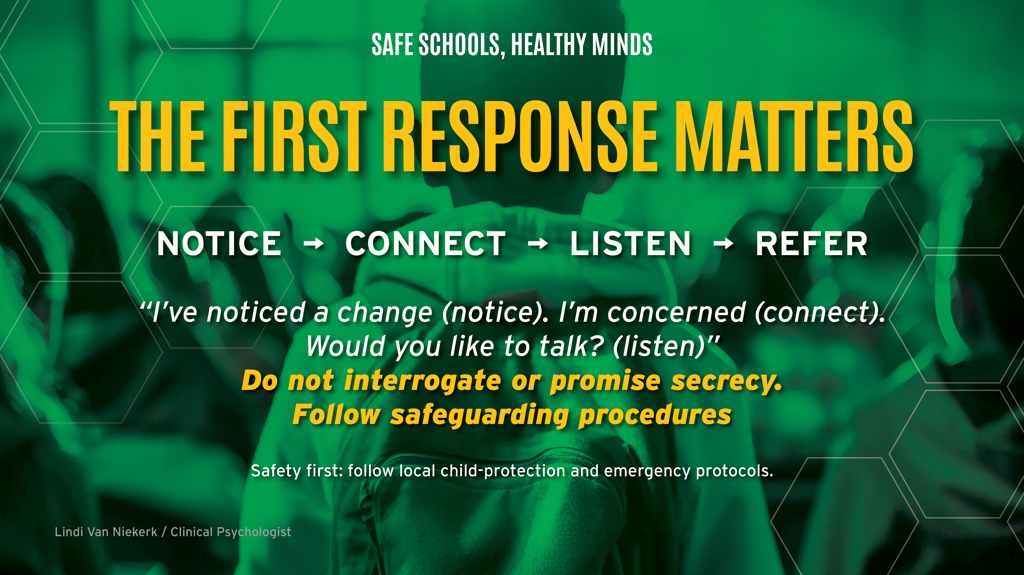
    When dealing with a distressed student, Lindi emphasizes that the first response is the most important. Drawing on the Zulu concept of sawubona (“I see you”), she reminds educators that acknowledging a student’s struggle—saying simply, “I notice you’re struggling”—creates the vital bridge needed before any other support or referral can take place.

    To help students build emotional awareness, Lindi introduced a simple yet effective tool called the MSG Mnemonic:

    • M = Mad
    • S = Sad
    • G = Glad

    If students cannot find the words to explain their internal state, categorizing emotions this way and using an intensity scale helps bridge the gap. Simple grounding exercises, such as slow breathing techniques or blowing bubbles and feathers, can also help regulate nervous systems in high-stress moments.

    The Starfish Principle: You Can’t Save Everyone

    One of the most liberating takeaways for educators is The Starfish Principle. Just like the man throwing stranded starfish back into the ocean, a teacher cannot rescue every single child in a classroom. However, you can make a profound difference for one child. Do what you can, every day, for those you can reach.

    Protecting the Caregiver

    Teachers and healthcare workers are notorious for taking on everything, often heading straight toward compassion fatigue and burnout. Lindi cautions that unaddressed personal trauma makes educators uniquely vulnerable to triggers in high-stress school environments.

    To prevent burnout, educators must:

    • Set Firm Boundaries: Recognize the limits of your role. You are an educator, not a licensed therapist or social worker; your job is to identify needs and safely refer students out.
    • Lean on Peer Support: Isolation is the death of good mental health. Share your challenges with colleagues who understand the daily realities of the classroom.
    • Pause and Refuel: Take moments to step back, seek out “glimmers” of hope in nature, and remember that it is entirely okay not to be okay.

    practical steps you can take

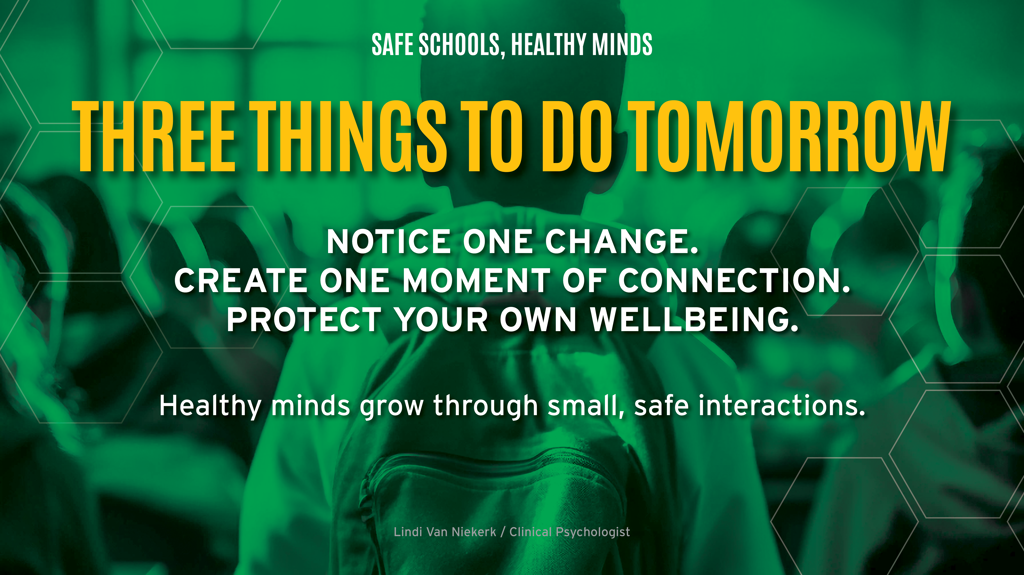
    Lindi’s talk had a very practical application. Empowering teachers to take real steps, while protecting their own well-being.

    Watch the full presentation on YouTube to dive deeper into Lindi van Niekerk’s invaluable insights on building healthy, resilient school communities: [Link to YouTube Video]

    more about lindi

    Lindi van Niekerk is a clinical psychologist, based in Simon’s Town, and partner for Upside. She provides all the supervision for our volunteer counsellors. You can find out more about Lindi here.

  • Current Financial Status

    This year has started for use with a real financial challenge. Here are the 4 figures we will track for our financials:

    Bare Minimum
    This is the minimum amount we need to pay our financial obligations. This is amount includes our current salary and wage bill.
    Target
    This is the amount we are targeting for this year. This allows us to give an increase to our two employees (who have not had an increase in 3 years!) and increase the scope of our supervision support to our counseling staff.
    Actual
    This is the amount of money we actually received in that month.
    Shortfall\Extra
    This shows the difference between out Actual and our Target amounts.

    As you can see from the above, we get the bulk of our income from a handful of loyal supporters without whom we would not be able to provide the service to the community that we do.

  • Why We’re Talking About Our Finances

    At Upside Community Services NPC, people often ask how we manage to do so much with so little.

    The simple answer is this:
    we are a very lean organisation.

    And we want to start being more open about what that actually looks like.


    A People-Centred Organisation Invests in People

    If you look at our finances, you will see that most of our spending goes toward people. That is not an accident — it reflects the nature of our work.

    We also want to pause and say a sincere thank you to every individual, family, organisation, and partner who has supported us — whether through financial giving, volunteering, professional input, encouragement, or prayer. Everything we do is possible because people choose to stand with us. Your generosity, trust, and belief in this work have allowed hundreds of individuals to receive care, support, and opportunity that would otherwise not have been accessible. We do not take that lightly, and we are deeply grateful that you continue to walk this journey with us.

    Our programmes are not buildings.
    They are not equipment.
    They are not large infrastructure projects.

    Our work happens in conversations, support sessions, training spaces, and community relationships. Our work happens with people and through people.

    So yes — the largest part of our budget is staff costs. Because people are how care, support, and change are delivered.

    But here is something many don’t realise:

    We only have two paid employees. And that 62% is equal to only R18 911 per month.

    Everyone else — including me, the Executive Director — serves in a volunteer capacity. That means the reach and impact of our work is carried by a small paid team supported by committed volunteers who give their time and energy because they believe in what we do.

    This is how we remain lean.
    This is how we stretch every rand.
    This is how we serve hundreds of people each year.


    Why We Are Sharing This Now

    Transparency matters.

    If people are going to support our work, they deserve to understand how resources are used and what it actually costs to deliver services in the community.

    So going forward, we are committing to greater financial openness.

    In this regular newsletter, we will begin sharing:

    • What our expenses look like
    • Where our income comes from
    • What our current financial needs are
    • What our funding goals are

    This will allow you — our supporters, partners, and community — to make informed decisions about how and whether you want to be involved.

    We believe accountability builds trust.
    And trust strengthens impact.


    Where We Are Right Now

    We operate on a tightly managed budget that keeps essential services running — but with very little margin.

    Our current expenses reflect a lean structure that prioritises:

    • service delivery
    • responsible governance
    • basic operational sustainability

    What they do not reflect is growth, expansion, or long-term staff development.

    And that brings us to an important reality.


    Our Next Step: Sustainable Growth

    Since Upside began, our full-time staff have not received salary increases — despite rising costs of living and growing service demand.

    They continue to serve faithfully, professionally, and sacrificially. But sustainability matters — not just for organisations, but for the people who carry them.

    Our short-term funding goal is therefore twofold:

    1. Strengthen and fairly support our existing full-time staff
    2. Allow measured expansion of our services to meet growing community needs

    This is not about becoming large or complex.
    It is about becoming sustainable and responsive.


    Why Your Support Matters

    Every year, hundreds of individuals and families receive care, guidance, and support through our work.

    That only happens because people choose to stand with us.

    By sharing our financial reality more openly, we are inviting you into the journey — not just as observers, but as partners.

    In the months ahead, we will clearly communicate:

    • what we need
    • why we need it
    • what impact it will create

    So that you can choose how you want to help.


    Thank You for Walking This Journey With Us

    We believe responsible stewardship and honest communication honour both our mission and our supporters.

    Thank you for caring about transparency.
    Thank you for caring about people.
    And thank you for helping make this work possible.