

Education is about much more than just hitting academic targets or getting through a packed curriculum. In today’s classrooms, teachers carry an immense load—acting not just as educators, but as managers, information providers, and frontline observers of children’s mental well-being. At the recent “Safe Schools, Healthy Minds” mini-conference, clinical psychologist Lindi van Niekerk delivered a powerful presentation addressing how educators can recognize trauma, build student resilience, and protect themselves from burnout.
The Three Lenses of Trauma
Lindi approaches her practice through three distinct lenses: as someone who survived and recovered from early trauma, as a former teacher who worked in challenging school environments, and as a clinical psychologist facing a staggering wave of trauma in private practice. This multi-faceted background gives her a profound empathy for both the struggles students face and the impossible weight placed on teachers.
Recognizing Trauma Through Behavior
Children and teenagers often lack the vocabulary to articulate complex emotional pain. Because of this, behavior is communication. Lindi warns educators not to automatically mistake aggression, irritability, withdrawal, or self-harm for simple naughtiness or disobedience.
- Changes from Baseline: The most vital indicator for teachers to watch for is a sudden shift from a child’s normal baseline behavior.
- Adolescent Warning Signs: In teenagers, behaviors like wearing long sleeves in summer can mask self-harm, which is frequently an attempt to regulate overwhelming emotions rather than a suicide attempt. Similarly, chronic substance use often stems from trying to numb deep pain.
Connection Before Correction
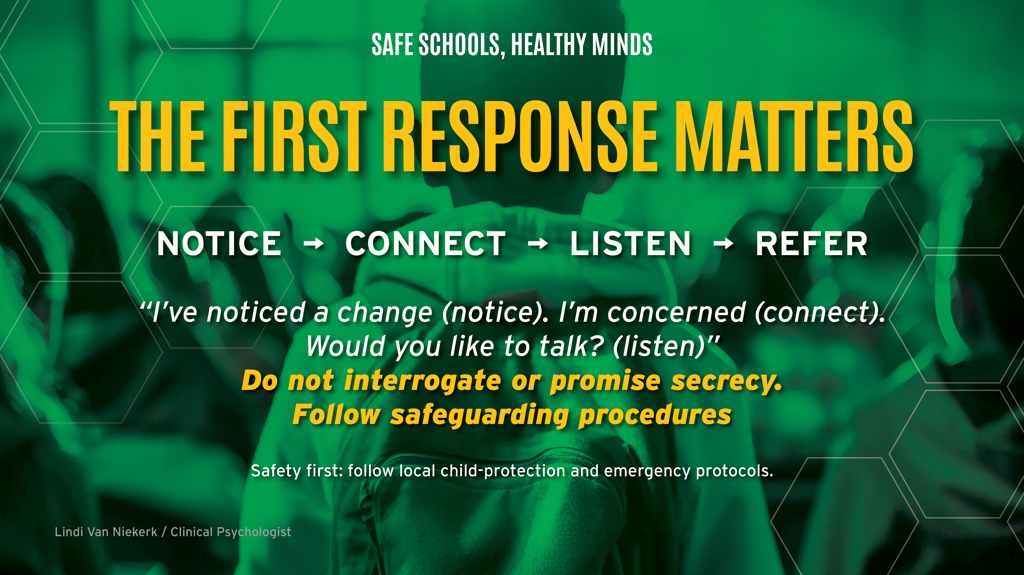
When dealing with a distressed student, Lindi emphasizes that the first response is the most important. Drawing on the Zulu concept of sawubona (“I see you”), she reminds educators that acknowledging a student’s struggle—saying simply, “I notice you’re struggling”—creates the vital bridge needed before any other support or referral can take place.
To help students build emotional awareness, Lindi introduced a simple yet effective tool called the MSG Mnemonic:
- M = Mad
- S = Sad
- G = Glad
If students cannot find the words to explain their internal state, categorizing emotions this way and using an intensity scale helps bridge the gap. Simple grounding exercises, such as slow breathing techniques or blowing bubbles and feathers, can also help regulate nervous systems in high-stress moments.
The Starfish Principle: You Can’t Save Everyone
One of the most liberating takeaways for educators is The Starfish Principle. Just like the man throwing stranded starfish back into the ocean, a teacher cannot rescue every single child in a classroom. However, you can make a profound difference for one child. Do what you can, every day, for those you can reach.
Protecting the Caregiver
Teachers and healthcare workers are notorious for taking on everything, often heading straight toward compassion fatigue and burnout. Lindi cautions that unaddressed personal trauma makes educators uniquely vulnerable to triggers in high-stress school environments.
To prevent burnout, educators must:
- Set Firm Boundaries: Recognize the limits of your role. You are an educator, not a licensed therapist or social worker; your job is to identify needs and safely refer students out.
- Lean on Peer Support: Isolation is the death of good mental health. Share your challenges with colleagues who understand the daily realities of the classroom.
- Pause and Refuel: Take moments to step back, seek out “glimmers” of hope in nature, and remember that it is entirely okay not to be okay.
practical steps you can take
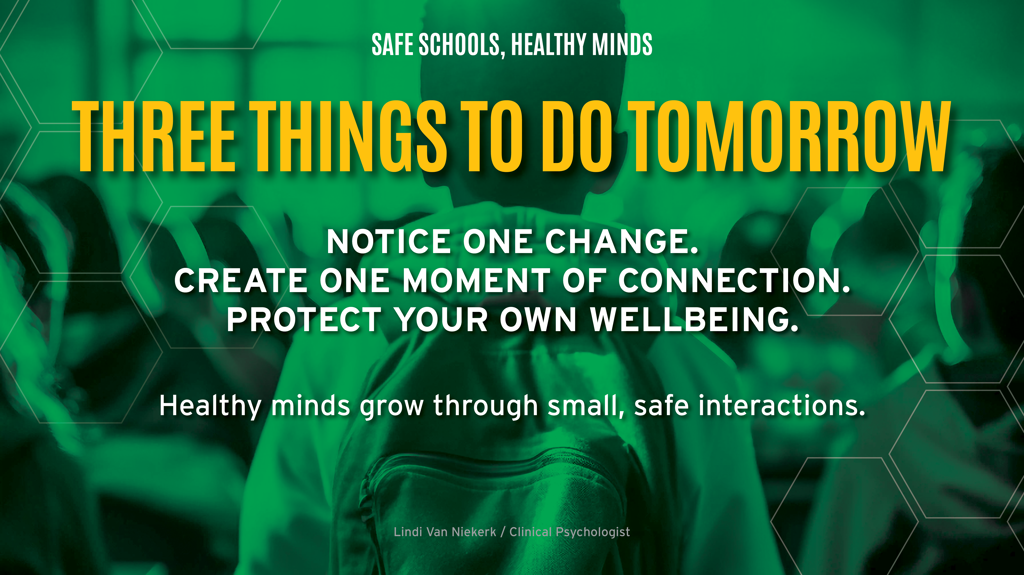
Lindi’s talk had a very practical application. Empowering teachers to take real steps, while protecting their own well-being.
Watch the full presentation on YouTube to dive deeper into Lindi van Niekerk’s invaluable insights on building healthy, resilient school communities: [Link to YouTube Video]
more about lindi
Lindi van Niekerk is a clinical psychologist, based in Simon’s Town, and partner for Upside. She provides all the supervision for our volunteer counsellors. You can find out more about Lindi here.
Leave a Reply